

You Cannot Replace the Wisdom You Have Already Fired
The AI rebound is already here, and strategy, not software, is the only way out.

A few weeks ago, I asked the people in my LinkedIn feed a question, without facts and without theses, just for their opinions: when we remove the human in the loop by automating a workflow, what happens to the human?
Eighteen comments came back, almost two thousand people saw it, and most of the answers were thoughtful. Paul Floren wrote this:
“There is a real paradox between knowledge and wisdom; it has always been there, but that becomes even more profound with AI. The gap is growing. So, in short, operational knowledge is being automated, but contextual wisdom is not. But this is a problem because much of our wisdom comes from learning and failing, and without this, we’re short on the tools that build it. So while the human gets pushed upstream, it might not be a human with all the talents (wisdom) needed for the role, or for life in general.”
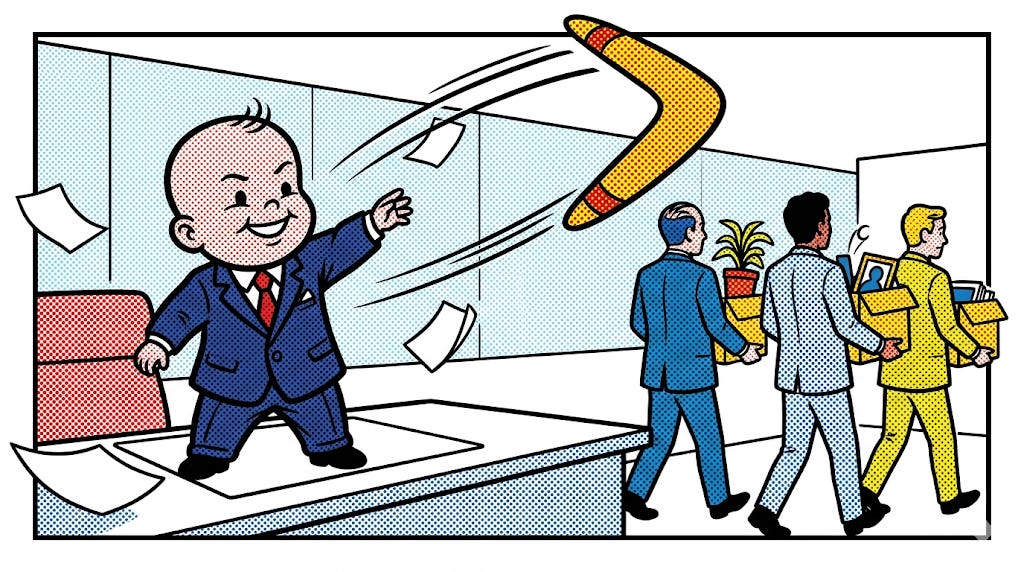
If Paul’s right, and I think he is, then a very large number of companies are about to discover that they’ve automated and fired the wrong thing. They’ve handed a toddler a paintbrush, not taught it the difference between a canvas and the walls and left it to make art.
Let me show you the receipts, then I want to talk about what’s actually going wrong, why a fifteen-year-old strategy framework explains it perfectly, and what the leaders still standing in 2027 will have done differently.
The boomerang isn’t a prediction, it’s a backlog
The Q1 2026 layoff data tells a story so consistent its earned a name in HR circles: the AI Hangover.
Klarna fired roughly 700 customer service agents over two years and let headcount drop 22%, with their CEO publicly boasting that AI was doing the work of 700 humans, and by May 2025 he was telling Bloomberg they’d gone too far, that the focus on cost had produced “lower quality,” and that the company was rehiring humans because human support had become a competitive advantage rather than a cost line (Fortune coverage here).
Forrester’s Predictions 2026: The Future of Work report found that 55% of employers already regret laying off workers because of AI, and they predict that roughly half of those layoffs will be reversed, often offshore or at lower wages, which means the institutional knowledge loss is permanent even as the headcount creeps back.
Thomas Davenport at Babson and MIT surveyed 1,006 global executives in January 2026 and found that 60% had reduced headcount in anticipation of AI’s future impact, while just 2% said large layoffs were tied to actual AI implementation. Sixty percent cutting for potential, 2% cutting for performance.
MIT’s NANDA project found that despite thirty to forty billion dollars in enterprise spending on generative AI, 95% of organisations are seeing no measurable financial return, and only 5% of custom enterprise AI tools ever reach production.
The market has noticed too: Goldman Sachs research from December 2025 found that stocks now drop about 2% on average after AI-attributed layoff announcements, the precise opposite of what was happening a year earlier when the same announcements pushed stocks up.
I’ve been through a few hype cycles by now, including blockchain, Internet of Things and the big digital transformation wave, and the same arc plays out every single time: the technology is real, the transformation is overstated, and the companies that survive are the ones who treat the new tool as a tool, while the ones who hand the keys of the kingdom to the toddler don’t. All that is happening now is it’s bigger, and much faster.
Klarna’s full arc, from “AI does the work of 700 agents” to “we have to rehire,” took about eighteen months, and Block cut 4,000 people in one announcement, but some analysts have questioned whether the company is “genuinely being transformed by AI or simply using it as a convenient rationale for cost cuts they would have made anyway.”
Where it’s actually going wrong
Before I tell you what to do about it, let me describe what I keep watching happen.
A company runs an AI pilot… let’s say a Series D logistics SaaS firm decides to test agentic AI inside its customer support function. It works beautifully because the team automates ticket triage, drafts standard responses, and summarises long conversations for handover. Productivity in that team improves measurably, they reduce headcount in support by 20%, and quality scores hold steady.
Leadership gets understandably excited, the pilot worked, and so they extrapolate.
Every department head receives a version of the same instruction: if support can do 20% more with 20% fewer people, surely you can too, and the number gets baked into the budget for engineering, for product, for finance, for operations, for sales, until the conversations stop being about whether AI fits the work and start being about how fast you can hit the target.
This is where the toddler picks up the paint.
In some functions, the 20% reasonably exists, because AP and AR ledgers, parts of finance, parts of HR ops, and large chunks of repetitive marketing operations are rules-based, well-documented, and high-volume work, and AI eats it for breakfast.
But in engineering, the 20% doesn’t exist in the same shape, because senior engineers don’t spend their days writing user stories, they spend their days holding context: they remember why the integration with that one customer’s billing system was built the way it was three years ago, they know which test suite is lying about coverage, and they know that the new junior PM doesn’t yet understand why we don’t let the marketing team change the API contract on a Friday.
Tell that team to hit a 20% AI-driven productivity gain and one of two things happens: either they use AI as augmentation, the way they should, and they hit maybe 8% to 12%, real and durable, or they cut the 20% you asked for and the wheels come off. Escaped defects climb, code that an LLM wrote merges into production with subtle bugs because nobody senior was left to review it, customer-reported quality drops, and the smartest people on the team realise they’ve become nannies for an enthusiastic toddler with a paint roller but no parental guidance, so they leave.
Here’s where the second-order damage starts, the part most boards don’t see coming until it’s far too late to fix it. The senior people who walked out are now somewhere else, often at a competitor, talking about what happened, and the talent market is small and incestuous, especially in tech, so within a quarter or two your company has a reputation: you’ll fire anyone the moment AI looks like a plausible substitute, and the work you ship is mediocre because the people doing it are cleaning up after a tool they don’t trust. The good people you’re now trying to hire have heard about all of this from their friends, the offers you’re making are being declined, and the offers being accepted are coming in 30% to 50% above what you used to pay, because the only people willing to walk into that mess are the ones charging a hazard premium.
One in three companies in the recent Careerminds survey reported spending more on restaffing than they ever saved from the original cuts. The dirty secret you tried to tuck behind a press release became your hiring problem.
The toddler has just ruined your sofa, and the nanny you hired to outsource proper parenting is not coming back.
Goldman’s analysis is sharper still: the companies announcing AI-driven layoffs in 2025 had higher capex, more debt, and lower profit growth than peers, which means the cuts weren’t innovation, they were papering over fundamentals.
The deeper problem is that all of this could’ve been seen in advance, because there’s a framework for this, and most of these leadership teams have just stopped using it.
Roger Martin saw this coming, in 2020
Roger Martin’s Strategic Choice Chartering essay, published on his Substack in 2020, is, in my opinion, one of the most useful and underused pieces of writing about how strategy actually works inside an organisation, and it’s short, so go and read it.
The argument, briefly: strategy is the paired choice of Where to Play and How to Win, and Martin is explicit that those choices aren’t made only at the top, because as he writes, “the President of Beauty Care also makes WTP/HTW choices, as does the Senior Vice-President of Hair Care, as does the Global Brand Franchise leader for Pantene, as does the US Brand Manager of Pantene.” The cascade runs all the way down, the CEO of P&G doesn’t pick the Pantene strategy, the Pantene team does, inside a charter the CEO has set.
Choices only get made well, Martin argues, if there’s “diligent strategic choice chartering from the top of the organization on down,” and he lays out six elements: make only the choices you’re best positioned to make, explain your choices and the reasoning behind them, specify the next downstream choice your direct report needs to make, help them make it, commit to revisiting your own choice if their feedback says it can’t be made, and ask them to repeat the process at the next level.
The fifth element is the one that AI-driven cost cutting is violating at scale, and Martin’s warning on this point is the cleanest indictment of the AI Hangover I’ve read: “if those arrows just flow down, the system isn’t self-correcting: it is self-sealing in a dangerous way.”
A self-sealing cascade is exactly what happens when leadership says “every department, 20%” and then refuses to hear the engineering VP explain that her department’s work doesn’t have 20% of removable scope without quality collapse, because the arrow runs down, the arrow doesn’t run back up, or it does run back up and gets ignored, because the layoff number has already been promised to investors.
Strategic Choice Chartering also gives us the most useful question for any AI deployment, the one almost no executive team is asking: what is the specific choice I’m asking the team in this function to make about how AI changes Where to Play and How to Win for them? That question, asked properly, function by function, produces wildly different answers, because customer support’s answer is different from engineering’s, and finance ops is different from product. The blanket “use AI to cut 20%” is not strategic chartering, it’s a target masquerading as one.
And here’s where Paul’s wisdom paradox comes back, because the people best positioned to make those local Where to Play and How to Win choices, the people with the contextual judgment to know where AI augments and where it would replace something irreplaceable, are exactly the senior operators currently being walked out the door. The framework requires the wisdom. The layoffs are firing the wisdom.
The reframe: efficiency is the wrong question
In the same comment thread on my original post, Troy Thiel wrote something I’ve quoted three times this month already:
“Investment in a new technology should be done to increase the pie, or your slice of the pie. I think ‘efficiencies’ to be gained from AI is a red herring. The conversation should be: what more can we do now?”
That’s the strategic flip. The companies running the AI-as-cost-cut playbook are running it because thats the question they asked, and AI is dutifully answering. The companies still standing in 2027 are asking a different question: given this new capability, what can we now do that we couldn’t do before? What new Where to Play just opened? What sharper How to Win is now possible?
Those companies aren’t freezing hiring, they’re reshaping it, and they’re putting AI in the hands of senior operators and asking those operators to chart the new ground, using the cascade properly, letting the arrows run both ways.
A specific example, anonymised. I know one company that ran the same support pilot everyone else did, with the same 20% number, but their CEO did something rare. She took the result to her exec team and said, we are not extrapolating this; each of you tell me what AI changes about your function’s Strategic choices, in your own words, with your own numbers, by next quarter. Some functions came back with productivity plans, others came back with growth plans, and one came back and said, “AI doesn’t move the needle here, but if we redirect the saved hours from finance ops into customer research, we can ship two new product lines next year.” A new charter, set inside a working cascade, by the people who actually understand the work.
What this means if you’re a board, a CEO, or a Chief Transformation Officer
Five things, plainly:
Stop extrapolating pilots across the org. A 20% gain in one function is information about that function, not a target for the rest of the company. Roger Martin’s first element of chartering is that you make only the choices you’re best positioned to make, and the CEO is not best positioned to decide how AI changes the engineering VP’s How to Win, the engineering VP is.
Run the cascade properly. Element five matters most (be willing to change your choice if the choice on the cascade down from yours proves it doesn’t work): build in the upward arrow, and if a function head tells you the 20% isn’t there in their work, believe them. Or, if you can’t trust them, fire them and find one you can trust*. Don’t pretend the cascade is self-correcting if you’ve already made the layoff target non-negotiable.
*= don’t confuse trust with sycophancy
Treat senior operators as your scarcest asset. They hold the contextual wisdom that AI can’t, and Forrester found only 16% of workers had high “AI readiness” in 2025, projected to reach 25% in 2026, which means your senior operators are the bridge between today’s organisation and the AI-fluent one you say you want to build.
Ask the Troy question, not the cost question. What more can we do now? AI as a growth lever produces a fundamentally different organisation than AI as a cost lever, and only one of those organisations is still standing in 2027.
If you’ve already cut, don’t pretend. One in three companies in the Careerminds survey reported spending more on restaffing than they ever saved, so the honest move is to acknowledge it, hire back deliberately rather than reactively, and rebuild the cascade. The dishonest move, hiring offshore at lower wages while the original team is still bitter on LinkedIn, is the one Forrester predicts most companies will take. The talent market is small, and the talent market remembers.
Before the next cut
I’ve spent 18 years inside transformations, and I’ve watched companies do the brave thing and the cowardly thing and the lazy thing and occasionally the brilliant thing. The ones who get it right share a single trait: they treat the technology as a tool and the framework as a discipline, and they trust the people who hold the wisdom that makes both of those work at all.
AI is the most powerful tool I’ve ever seen handed to a workforce, and it’s also the easiest one to misuse, because it produces output that looks intelligent even when the judgment behind it isn’t.
Roger Martin’s framework is 15 years old and it remains as sharp as the day he published it, because the cascade still runs both ways and the wisdom still lives in the people doing the work.
You can hand an LLM a charter, but you can’t hand an LLM the contextual wisdom of a senior operator with eight years of customer scars on her hands, because that wisdom doesn’t live in the documentation, it lives in the people who are still in the building.
So before the next round of cuts, before the next 20% mandate cascades through your org, sit with this one for a moment:
You cannot replace the wisdom you have already fired.
more people need to hear this "you can’t hand an LLM the contextual wisdom of a senior operator with eight years of customer scars on her hands"